The situation this playbook is built for
The test graph shows a low number. One screenshot points to radio quality, another to PRB allocation, and a third uses a throughput value measured at a different boundary.
Before asking for a parameter change, the investigation needs four things:
- a frozen traffic-test contract;
- proof that traffic demand existed;
- a name and time window for every throughput value;
- one controlled comparison that can separate competing explanations.
The playbook puts those four things into one portable sequence.
What is inside
- the first ten minutes of a low-throughput investigation;
- a traffic-test contract for direction, endpoint, protocol, streams, UE, subscription, position and clock;
- a map of the different boundaries that can all be called throughput;
- a four-branch diagnostic tree;
- radio-efficiency versus scheduler-allocation checks;
- transport and endpoint discrimination;
- a two-UE, two-SIM policy and device matrix;
- a last-positive / first-divergence evidence table;
- a concise engineering handoff template;
- public technical references and explicit claim boundaries.
Two diagrams built for field decisions
One flow, multiple throughput numbers
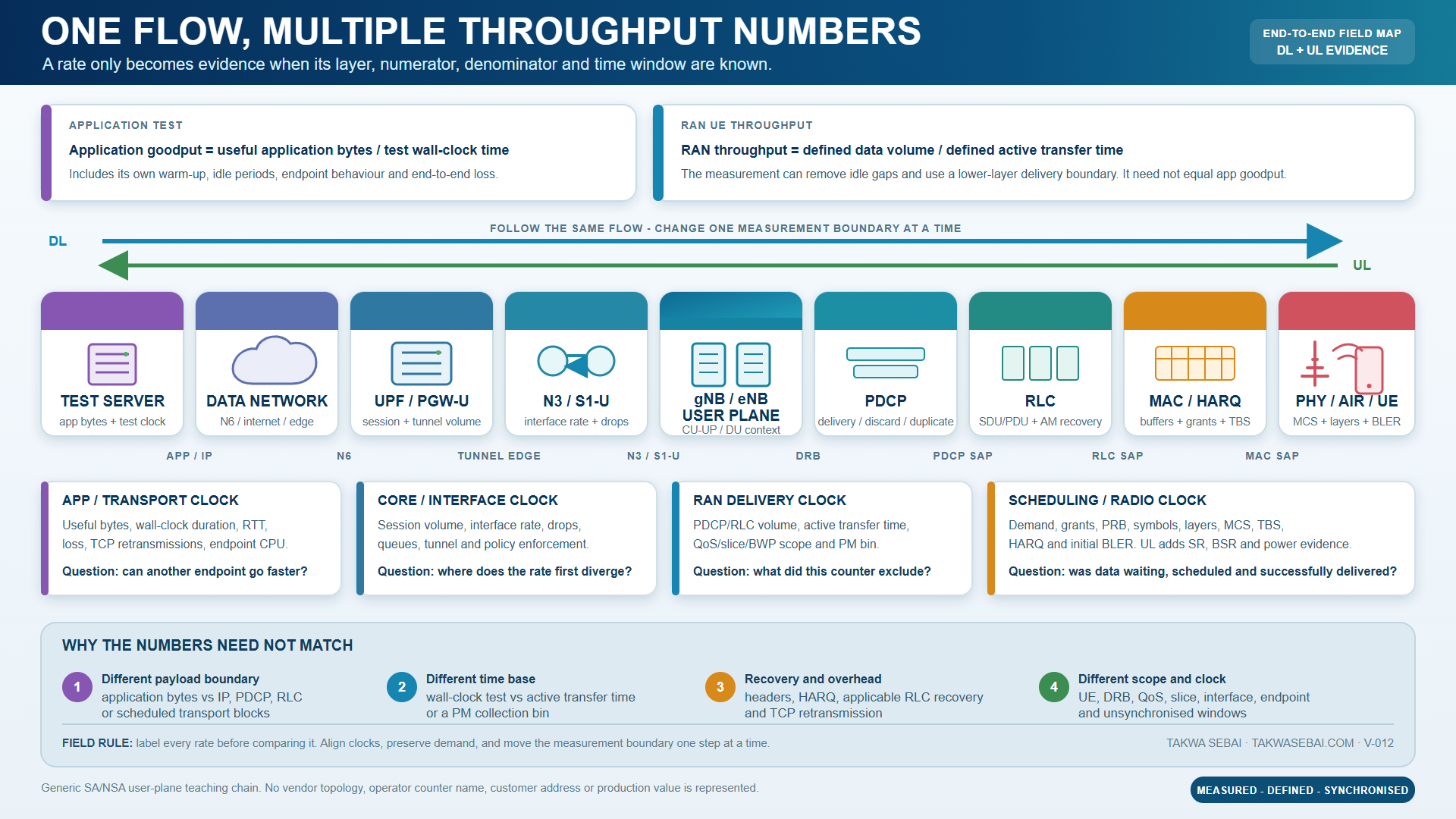
Application goodput, PDCP delivery, MAC or PHY throughput, RAN PM values and transport-interface volumes can differ legitimately. Name the boundary, direction, payload definition and time window before comparing them.
Split the symptom into four evidence branches
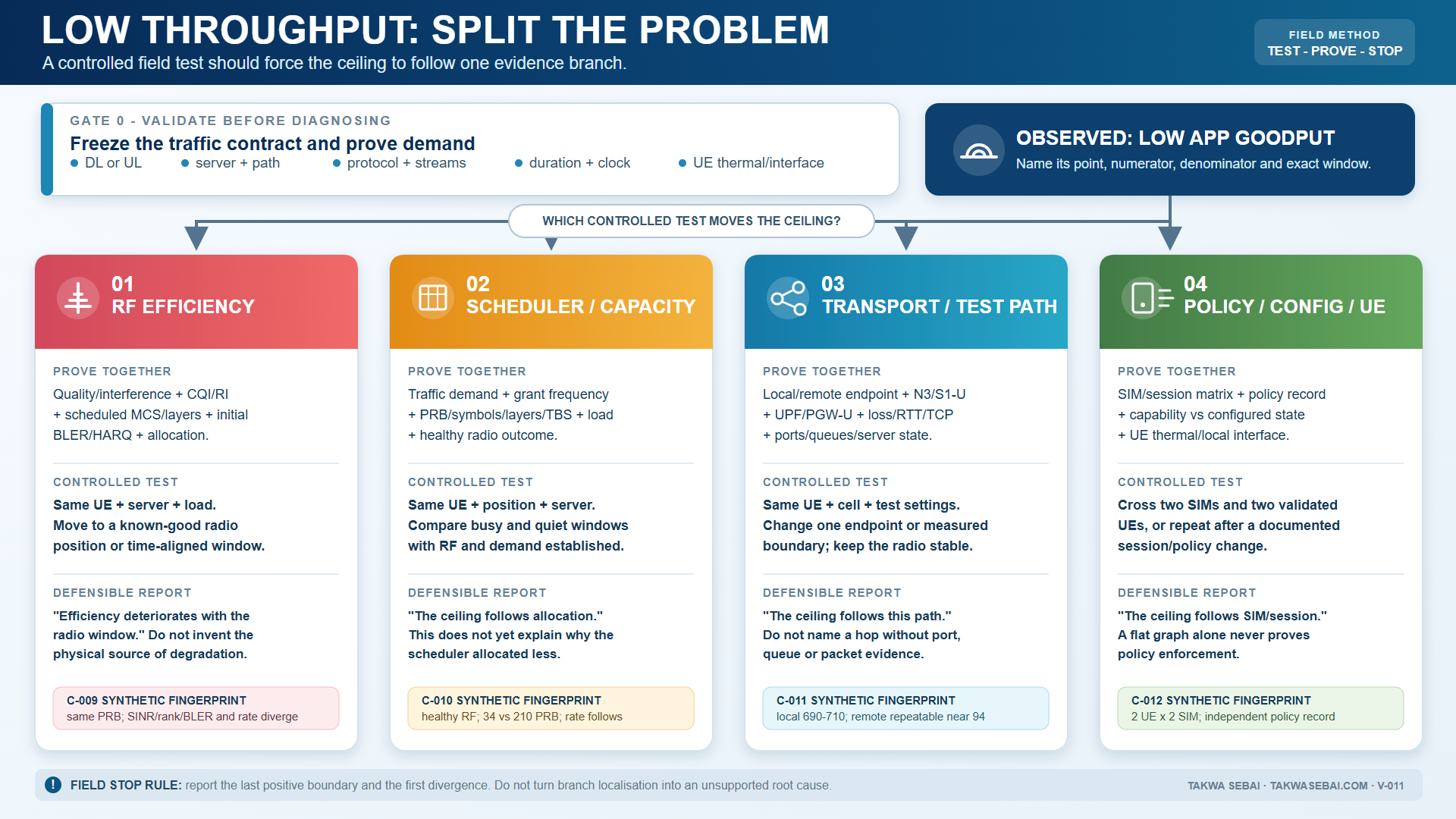
The tree separates:
- radio quality and efficiency;
- scheduler, allocation and capacity;
- transport and the traffic-test path;
- policy, configuration and UE context.
Both diagrams are original Takwa Sebai resources and retain their embedded versioned attribution.
How to use it during a first investigation
- Freeze the test setup before comparing results.
- Confirm that the application requested enough traffic.
- Label each throughput number by measurement point and interval.
- Check efficiency and allocation as different questions.
- Change one boundary at a time.
- Record the last positive evidence and the first divergence.
- Stop the conclusion where the evidence stops.
The objective is not to make the case look complete. It is to make the next test discriminating and the engineering handoff reproducible.
What it can and cannot establish
The playbook can help localise the ceiling to an evidence branch.
It does not:
- guarantee a root cause;
- provide hidden vendor parameters;
- define universal KPI thresholds;
- identify a failing transport hop without interface evidence;
- prove policy enforcement from a flat graph;
- replace authorised operating procedures;
- make confidential traces safe to upload or share.
Synthetic examples and evidence boundary
The four numerical fingerprints labelled C-009 to C-012 are declared
synthetic training examples. They are not customer incidents, network
benchmarks, Takwa Sebai field results or commercial performance claims.
The playbook contains no customer trace, operator identifier, proprietary vendor screenshot or restricted training page. Its technical statements are paraphrased from public ETSI specifications and original editorial frameworks.
Created and published by Takwa Sebai
This playbook is part of the Takwa Sebai telecom field-guide collection on
takwasebai.com.
Every PDF page carries:
TAKWA SEBAI - TAKWASEBAI.COM
Each diagram also carries:
TAKWA SEBAI · TAKWASEBAI.COM · V-011 or
TAKWA SEBAI · TAKWASEBAI.COM · V-012
The visible attribution helps preserve authorship when individual pages are shared. It is not presented as a technical restriction against screenshots or cropping.
Rights and permitted use
Copyright Takwa Sebai. All rights reserved.
Personal reading and internal evaluation are permitted. Redistribution, resale, removal of attribution, or reuse in training, a product or another publication requires written permission.
FAQ
Is the playbook free?
Yes. This compact public sample is downloadable without an email form.
Does it contain real customer cases?
No. The numerical fingerprints are explicitly declared synthetic exercises. No customer, operator or employer material is included.
Will it identify the root cause of every low-throughput case?
No. It helps localise the first divergence and choose the next controlled test. Some investigations will still require authorised vendor, transport, core or device evidence.
Is it the same as the full 5G NR field guide?
No. The playbook is a focused 12-page triage sequence. The 111-page field guide covers the wider site-to-trace path, including numerology, BWP, SSB, PDCCH, radio measurements and mobility.
Can I reuse the diagrams in training or another publication?
Not without written permission. Personal reading and internal evaluation are permitted, but redistribution and reuse in training, products or publications are not included.
Do I have to submit traces or personal data?
No. The download requires no form, and the landing page does not ask for case content.
KEEP THE INVESTIGATION INSIDE THE EVIDENCE
Name the test. Split the symptom. Choose one controlled comparison.
Download the 12-page playbookEnglish · PDF · 12 pages · Watermarked · No email required