I ran a balanced QUIC upload campaign from a test phone to a controlled remote endpoint. The intended comparison was narrow: on this device and this mobile path, did sender-side BBR or CUBIC produce a different distribution of application goodput?
Ten transfers completed. Five used BBR and five used CUBIC.
That did not create ten valid 5G NSA observations.
Only one run from each algorithm proved the radio state required by the pre-declared contract. I therefore rejected the comparison and published no winner.
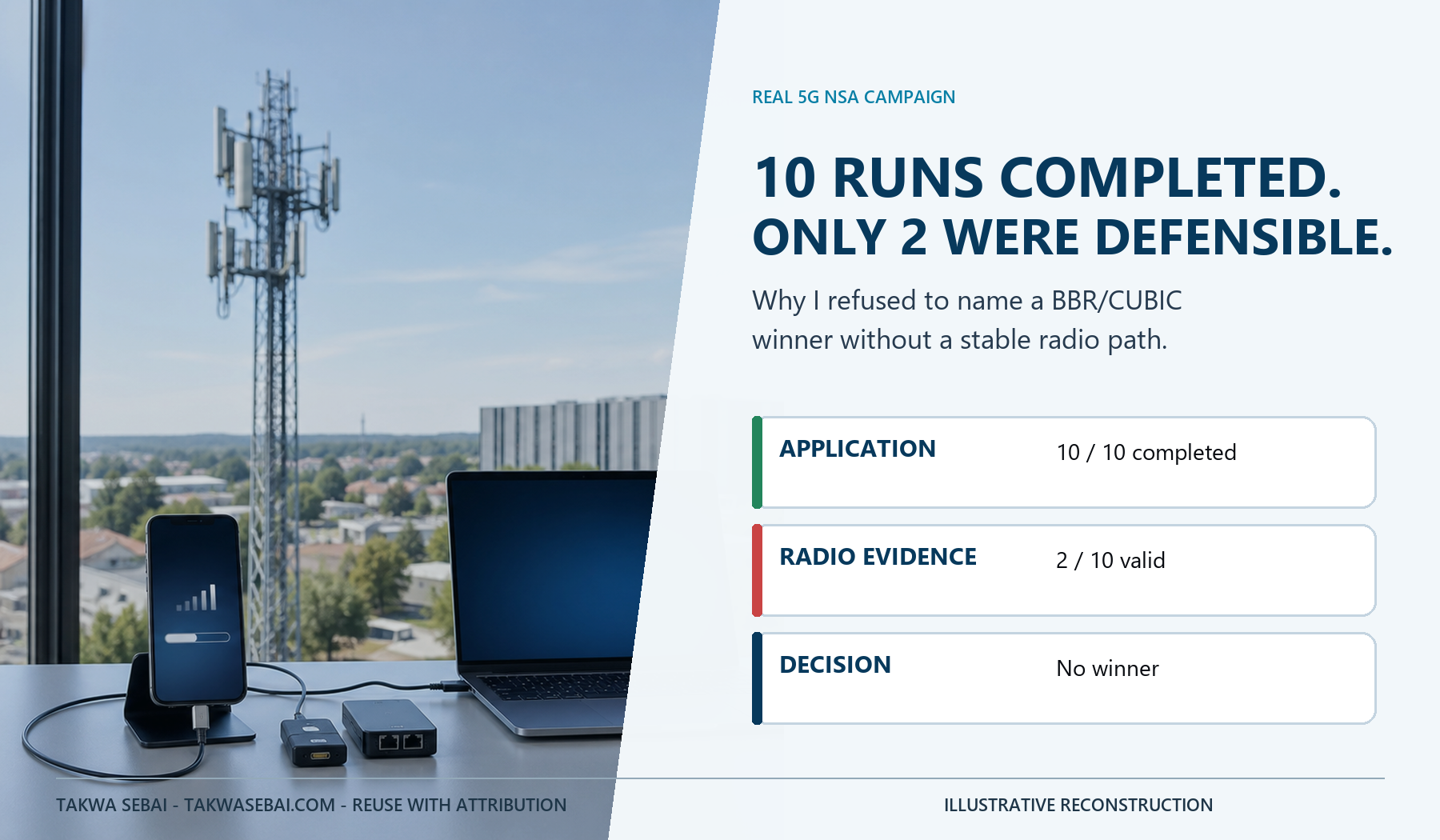
Real campaign by Takwa Sebai. The laboratory and network scene is an illustrative reconstruction, not raw evidence.
Direct answer
A successful upload proves that the application completed its transfer. It does not prove that every transfer used the same 5G NSA user-plane path.
This campaign required six linked conditions:
- the application transfer completed;
- the phone used the controlled mobile route and endpoint;
- NR activity was visible in the scored transfer window;
- the LTE anchor remained stable;
- client, server and radio evidence could be aligned;
- five valid runs survived for each algorithm.
The application condition passed ten times. The complete evidence chain passed twice.
One BBR observation and one CUBIC observation were below the pre-declared minimum, so no comparative conclusion was accepted.
The campaign contract
The question was not whether one congestion-control algorithm is universally better on 5G.
The bounded question was:
On one controlled terminal, mobile path and remote endpoint, do balanced sender-side BBR and CUBIC uploads produce different observed application-goodput distributions?
Before traffic, the campaign fixed:
- one Android terminal and one SIM;
- Wi-Fi disabled;
- one controlled remote endpoint;
- one traced MsQuic version on client and server;
- upload direction from the phone;
- one connection and one stream;
- five BBR and five CUBIC runs in a balanced sequence;
- a separate warm-up excluded from the result;
- radio evidence before, during and after each run;
- a mobile-data hard stop below the authorised allowance;
- a minimum of five valid runs per algorithm.
The preflight passed 54 checks. The client-server clock offset remained inside the declared limit. The server listener, software build and clock state were recorded.
Those controls established a defensible transport experiment. They could not force the live NSA radio state to remain inside the comparison contract.
What the controlled endpoint contributed
The remote server existed for measurement, not for website hosting or marketing delivery.
It removed several avoidable unknowns:
- the destination remained fixed;
- the software version and binary were traceable;
- the UDP listener was controlled;
- the server service and clock state were captured;
- the sender on the phone selected BBR or CUBIC;
- the campaign did not depend on an unknown public speed-test endpoint.
The server could prove the controlled transport destination. It could not prove which radio bearer carried a particular transfer. That evidence had to come from the terminal and its time-aligned logs.
Ten application successes, two valid radio observations
Every scored transfer returned successfully at application level.
The independent radio review produced this disposition:
| Run group | Application result | Radio evidence decision |
|---|---|---|
| R01, BBR | Completed | Valid: NR bearer active, LTE anchor stable |
| R02, CUBIC | Completed | Valid: NR bearer active, LTE anchor stable |
| R06, CUBIC | Completed | Invalid: NR activity present, LTE anchor changed |
| Seven remaining runs | Completed | Invalid: no NR bearer allocation proved in the transfer window |
The decoded logging evidence corroborated NSA addition and NR MAC/PDSCH activity for R01, R02 and R06.
That did not rescue R06. The LTE anchor changed between the required observations, so its path was not comparable with the accepted pair.
The seven remaining runs were not labelled LTE-only. The evidence did not prove an active NR bearer during their scored windows. "Not proved" is a narrower and more accurate result than "definitely absent".
Why a 5G NSA indication was not sufficient
An NSA indication on a screen is useful context. It is not a time-aligned user-plane bearer record.
The device can be in an NSA-capable context while the availability and use of NR resources change around individual application transfers. If those transfers are placed in the same comparison set without bearer evidence, the chart may combine different radio paths under one convenient "5G" label.
For this test, the required state was:
- fresh NR activity inside the transfer window;
- one stable LTE anchor across the run;
- the same controlled destination and mobile route;
- a completed application transfer;
- correlatable clocks.
Only the complete chain made a run eligible.
Why the goodput table is not public
One valid BBR run and one valid CUBIC run are observations. They are not a distribution.
The contract required five valid runs per algorithm. Publishing the two surviving values as a result would quietly replace the rule after the data became inconvenient.
The invalid-run goodput values are also withheld from this public derivative. They remain useful for private engineering review, but placing them beside the algorithm names would invite a comparison that the radio evidence has already rejected.
This is not data cleaning based on performance. No run was removed for being slow. Runs were rejected because their observed path violated a condition declared before traffic.
What the rejected comparison teaches
The campaign established three practical findings.
Completed is not valid
A green process exit proves that the transfer ran. It does not close the route, bearer and radio-state evidence.
NSA context is not NR traffic proof
The status indication and the decoded bearer activity answer different questions. The first provides device context. The second helps establish what was active during the measurement.
Validity comes before performance
The evidence gate must run before median, percentile or winner calculations. Otherwise the measurement can become a selection exercise in which only convenient states survive.
The real-time gate for the next acquisition
The next runner now has a conditional radio gate:
- generate a short unscored traffic prime;
- wait for fresh evidence that the NR bearer is active;
- record and lock the observed LTE anchor;
- start the scored upload only while both conditions remain true;
- stop immediately if the NR bearer disappears, the anchor changes or the evidence feed becomes stale.
Eight local tests cover its acceptance and failure branches.
The gate remains disabled for the closed campaign. A future execution requires a new contract, explicit activation and a separately authorised mobile-data budget.
The controlled endpoint may also support future HTTP upload scenarios from the application. Those measurements will be a separate campaign. Their request method, payload, timing, server receipt and radio gate must be declared before traffic; they cannot be merged retrospectively with the QUIC result.
What I would sign off
I would sign:
Ten balanced application transfers completed. Two runs, one BBR and one CUBIC, met the full radio validity contract. The surviving sample was below the pre-declared minimum, so no comparative conclusion was accepted.
I would not sign:
- BBR was faster than CUBIC on 5G;
- CUBIC was faster than BBR on 5G;
- eight runs failed because of poor radio quality;
- the operator caused the inconclusive result;
- the two valid observations predict another device, place or time.
A reusable mobile-throughput acceptance record
Use this table before interpreting a transport comparison:
| Evidence layer | Required record | Stop condition |
|---|---|---|
| Test contract | Direction, endpoint, sequence, duration and minimum sample | Contract changes after data |
| Application | Successful transfer and defined goodput output | Process or parser failure |
| Route | Mobile interface and controlled destination | Route changes or becomes unknown |
| NSA bearer | NR activity in the scored transfer window | Bearer absent or evidence stale |
| LTE anchor | Same anchor across the accepted run | Anchor changes |
| Time | Correlatable client, server and radio clocks | Event order cannot be defended |
| Publication | Enough valid runs for each branch | Minimum sample not met |
The stopping rule is:
Report the first missing proof. Do not turn a completed transfer into a conclusion that the radio evidence cannot support.
Technical references
- Microsoft MsQuic SecNetPerf documentation for the performance tool, upload mode and BBR/CUBIC selection.
- ETSI TS 137 340 V18.7.0 for the E-UTRA/NR multi-connectivity architecture used as standards context.
These references define the tooling and architecture context. The run disposition comes from the campaign evidence, not from the specifications.
For a wider diagnostic workflow, continue with the 5G low-throughput troubleshooting guide or download the free 5G NR field guide.
Copyright Takwa Sebai - takwasebai.com - Reuse with attribution
KEEP THE EVIDENCE PATH