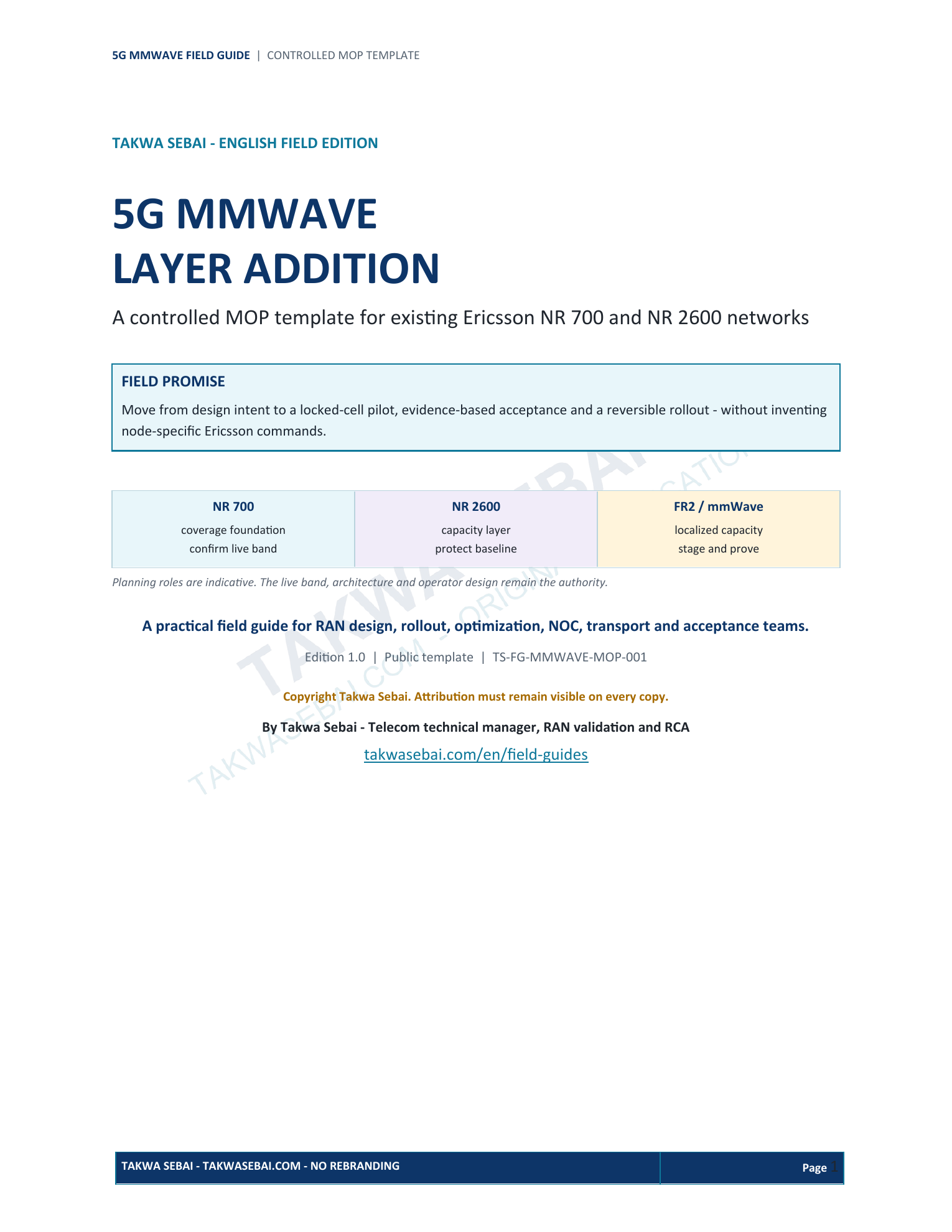
A controlled field template for teams adding an FR2 layer to a live Ericsson network while protecting the existing NR 700 and NR 2600 service.
What this guide gives you
- a seven-gate path from scope freeze to monitored closure;
- a site-specific input sheet that exposes missing design data before the change window;
- a command-neutral installation and activation sequence for a locked-cell pilot;
- checks for alarms, power, fibre, transport and synchronization;
- RF, mobility, throughput and voice-continuity acceptance cases;
- explicit rollback triggers and containment order;
- execution, command-sheet, evidence and residual-risk registers.
The rollout path
- Freeze the exact site, sectors, architecture and licensed FR2 spectrum.
- Prove site, power, fibre, timing, structural and exposure readiness.
- Introduce hardware and configuration while the new cell remains locked.
- Activate one approved cell or sector and collect end-to-end evidence.
- Compare the result with the frozen NR 700 and NR 2600 baseline.
- Expand only after explicit acceptance and a new scope decision.
- Close with an as-built pack, observation record and owned residual risks.
What is deliberately not included
The guide contains no guessed AMOS, ENM or managed-object commands.
Exact object names, feature keys, radio compatibility, software dependencies and rollback commands vary with the installed Ericsson hardware, RAN release, licensed features and operator design. They must come from the current Ericsson CPI and the approved site-specific configuration package.
Who it is for
- RAN design and configuration engineers;
- rollout and field-integration teams;
- transport and synchronization engineers;
- NOC and performance teams;
- RF optimisation and acceptance engineers;
- technical managers reviewing readiness, risk and evidence.
Why the existing layers remain the reference
The labels NR 700 and NR 2600 do not prove the live bands, frequencies or architecture. The template requires those values to be confirmed from the node export and approved design.
The existing service remains the baseline. A successful FR2 cell unlock is not acceptance if alarms, mobility, transport, voice or existing-layer KPIs regress beyond the approved limit.
Evidence and rights notice
This public guide is an educational and planning template, not an authorization to execute a live-network change. Operator approval, vendor approval, spectrum authorization, safety permits and site-specific scripts remain mandatory.
Every page carries the Takwa Sebai watermark and a permanent no-rebranding footer. The PDF metadata identifies Takwa Sebai as the author and includes document ID TS-FG-MMWAVE-MOP-001.
Personal study and internal planning are permitted. Rebranding, resale, commercial redistribution and publication under another name are prohibited.
Is the download free?
Yes. The 24-page English PDF is a direct download. No email address, account or case data is required.
Can I execute it as written?
No. First complete every site-specific field, attach the approved Ericsson delta and rollback packages, record the required signatures and stop at the first missing proof.
What should I do after the pilot?
Keep the evidence chain aligned: configured state, active state, scheduled resources and delivered service. Expand only when the intended state transition and the absence of regression are both demonstrated.